
Reposted from my Substack.
Warning: This musing is spoiler-filled for all seasons of The Mandalorian.
In the midst of its wackiness and big swings, I really enjoyed the religious subplot of Season 3 of The Mandalorian. Since the first episode, the spiritual practice and religious commitments of the Children of the Watch have been the butt of many a joke and have rarely been taken all that seriously outside of the show itself. Nevertheless, it has been one of the most intriguing aspects of the story for me. I am a pastor as well as a community organizer and a writer, after all, so perhaps that is only natural. However, I think the Children of the Watch haven’t been given the credit they perhaps deserve.

For frequently good reason, religion attracts a large share of detractors in the North American and European locales that made The Mandalorian and comprise a significant portion of its audience. The Catholic Church has made very few good headlines in decades as it has failed to reckon with the institutionalized sexual abuse in its ranks. We’ve seen similar abuse scandals emerge in other traditions, like the Southern Baptist Church that I grew up in (but have long since left). Even scandal-free religious institutions face questions about their utility, contribution, and ethics on a daily basis. The most inclusive and expansive incarnations of various religious traditions get swept up in the sins of their more violent and exclusive cousins, as well.
So, I don’t wonder at the fact that most people didn’t have a very positive opinion of the Children of the Watch or their high priestess, the Armorer.
The Armorer herself was the subject of many theories that, I believe, were born out of the disdain for organized religion in the so-called Western world. Again, this is not to say that that disdain doesn’t have some good justification (it does), but I believe it prevented many viewers from appreciating or even noticing a fascinating religious arc in The Mandalorian that stretches back to Season 1.
When we meet the Armorer in Season 1, she’s running the Mandalorian covert on Navarro. She spends her days crafting tools and armor for the group, managing supplies for the foundlings, and seeing that the expectations of the community were met. The Mandalorians live in a ghetto, of sorts, perhaps in some ways inspired by the Jewish ghettos of Europe in the nineteenth and twentieth centuries. Every move she makes is about preserving that community from outside forces that would destroy it. If you understand that motivation, you see the character differently.
Many speculated that the Armorer would be a turncoat from the beginning, which I think was borne out of this suspicion of organized religion. In reality, the Armorer is the leader of an exilic community cut off from the land of their origin and simply trying to survive. There is a lot about the Way and the Armorer that echo the context in which much of the Jewish Scriptures were written. The Jewish prophets and writers found themselves exiled from their homeland and subsisted in isolated communities where their practices and faith kept them together and helped them survive. (That situation has repeated itself in numerous Jewish Diasporas throughout history, too.)
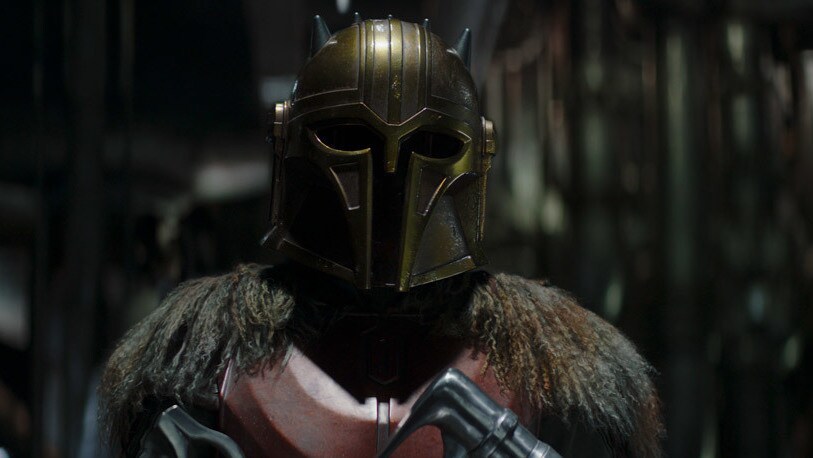
Religion has always been a mode of survival as much as it has been used as a tool of oppression. Religion, particularly when the given faith is in the minority, often serves an adhesive role for community, maintaining cohesion in the face of exclusionary, discriminatory, and oppressive forces. That’s the context in which we first encounter the Children of the Watch. Their ‘silly rules’ and strictures aren’t about preserving the Armorer’s authority (after all, we see the Children of the Watch actually function fairly democratically when making a significant decision), they are about preserving the community.
(You can read more about the Jewish analogues with the Mandalorians here, including their mikveh/Living Waters, menorah/Great Forge, Promised Land/Mandalore, etc.)
I was really fascinated by the religious movement in Season 3, after the Mandalorians have struggled to maintain their community through numerous trials and persecutions. This season, the Armorer was faced with a significant theological question: Was the strict adherence to one way of being Mandalorian still preserving the community or was it beginning to threaten it? Could Mandalorians survive without change or was change necessary for survival?
This same question gets batted about in the Jewish and Christian scriptures with which I am most familiar. There are warring narratives in the Jewish prophets that advocate for both inclusion (parts of Isaiah) and exclusion (parts of Ezra-Nehemiah). The early Christian leaders also clashed over the role of outsiders being included in their faith community. Did Gentile Christian need to become Jewish before they could follow what Luke (the Gospel writer, not Skywalker) calls The Way? Or did they believe God had some expansive goals in mind for their religious community? This push-and-pull is inherent in any community, not just religious ones, but it is particularly and obviously present in faith communities.
The Armorer eventually makes the move that many Jewish prophets, many early Christian leaders (like Paul), and many religious leaders today make: inclusion over exclusion. I work in a church that has been attempting to actively dismantle some of the exclusionary impulses within American Christian traditions. We engage in anti-racism work as well as deliberately inclusive LGBTQ ministry. When people show up in our congregation (usually because of the LGBTQ Pride and Black Lives Matter flags by our sign), they often are in some degree of shock that a religious community like ours exists.
That’s what I thought was so exhilarating about the Armorer in particular this season. When confronted by information that challenged her faith, she changed. Bo-Katan came to her and told her about seeing the mythosaur, something that conflicted with the Armorer’s understanding of her faith, and while she struggled to grapple with it at first, the Armorer relents and lets it change her. A few episodes after Bo-Katan’s revelations, the Armorer invites Bo-Katan into the inner sanctuary. She tells her to remove her helmet, which the Armorer had previously prohibited under pain of an arduous repentance process. Then, the Armorer tells Bo-Katan that she can walk both worlds and unite the Mandalorians.
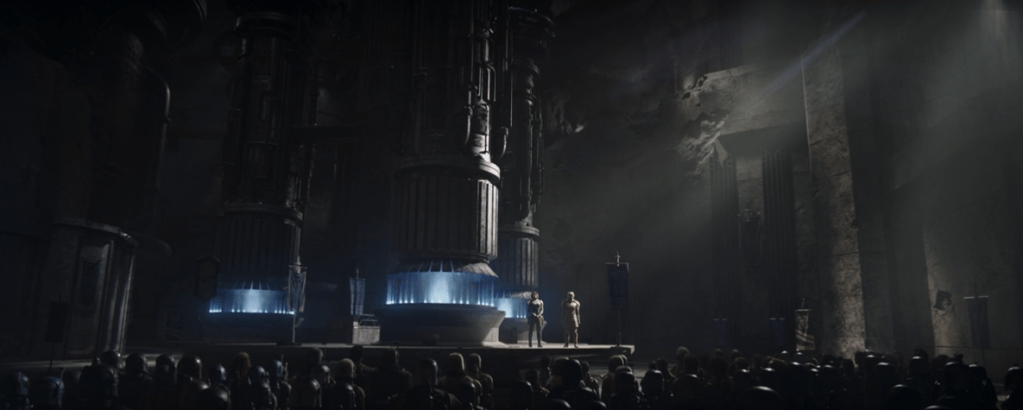
The stunning reversal represents not just mere tolerance of different ways of being Mandalorian, but an inclusive religious vision for her people that made space for others. Like Peter, who in the Christian traditions becomes an advocate for inclusion after a vision challenged his preconceptions, the Armorer expands her definition of what it means to be faithful. The move pays off as one of the final visions we see in Season 3 is a mixed crowd of Mandalorians with and without their helmets celebrating their return to their promised land. Notably, as well, the Armorer does not require Grogu to take a helmet when he becomes an apprentice Mandalorian and Ragnar Vizla doesn’t recite anything about wearing a helmet when he takes the creed at the Living Waters.
Season 3 of the Mandalorian is a deeply religious story about the persistence and value of a community of people bonded by covenant commitments. I hope it opens people up to the positive role religion can play (though by no means do I hope they give up on its critique). I hope that it shows existing religious communities how they can become catalysts of inclusion and healthier expressions of their traditions, as well.
 Wesley Spears-Newsome